Why Microsoft Foundry Is the New Command Center for Developers
The landscape of software development has shifted dramatically over the past few years. We’ve moved from simply integrating basic API endpoints into existing apps to architecting autonomous, multi-agent systems that can reason, orchestrate complex workflows, and execute tasks across enterprise tech stacks.
Enter Microsoft Foundry.
Whether you’re a pro-code developer scaling multi-agent networks or an ML engineer tuning model performance, Microsoft Foundry has quickly emerged as the unified platform designed to take AI apps from quick prototypes to production-ready enterprise systems.
Here is a breakdown of what Microsoft Foundry brings to the table and why it matters for modern software development.
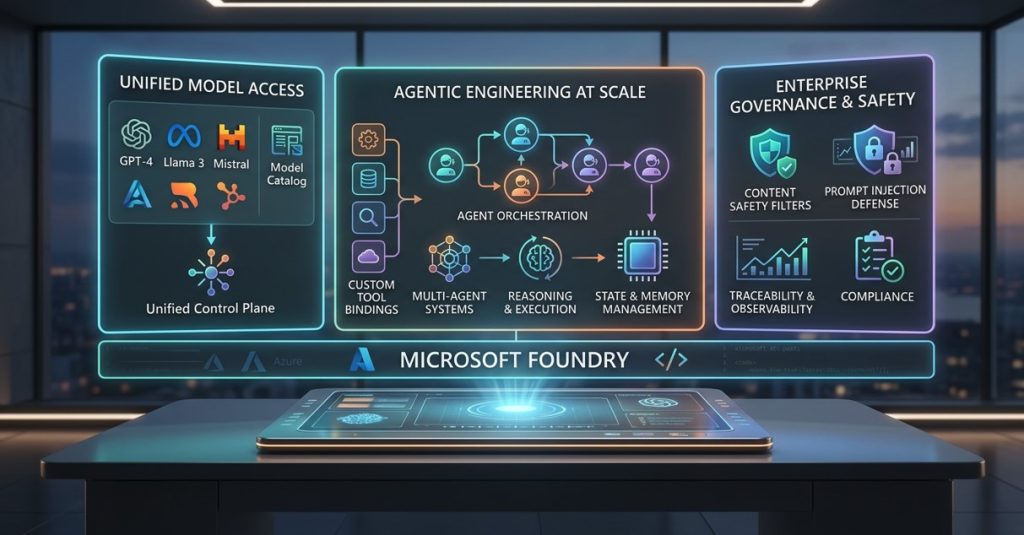
1. Unified Access to Models and Infrastructure
Building AI applications used to mean juggling different providers, managing fragmented API keys, and wrestling with inconsistent orchestration tooling. Microsoft Foundry consolidates this experience into a cohesive ecosystem.
Through a single control plane, teams gain seamless access to:
Diverse Model Catalog: From cutting-edge frontier models (OpenAI, Meta Llama, Mistral) to specialized industry models, enabling developers to select, compare, and benchmark the right model for specific workloads.
Integrated Tooling: Native support for vector stores, custom retrieval-augmented generation (RAG) pipelines, and external API connectors without requiring custom glue code.
2. Agentic Engineering at Scale
While standard completion APIs handle simple prompts, modern AI strategy relies on agents, systems capable of autonomous task execution, tool use, and multi-step reasoning. Microsoft Foundry is built specifically around this agent-first paradigm.
Agent Orchestration: Design multi-agent workflows where specialized agents handle dedicated sub-tasks (e.g., data fetching, compliance checking, execution) and collaborate in real time.
State & Memory Management: Native handling of long-term memory, conversation state, and contextual context windows so agents remain coherent across complex sessions.
Custom Tool Bindings: Safely expose internal microservices, enterprise databases, and third-party APIs directly to agent networks with granular permission scopes.
3. Enterprise-Grade Safety, Governance, and Trust
Transitioning an AI project from proof-of-concept (POC) to production usually hits a wall around compliance, security, and observability. Microsoft Foundry embeds governance directly into the development cycle rather than treating it as an afterthought.
Built-in Content Safety: Guardrails, prompt-injection defence, and automated evaluation metrics run on every request to prevent hallucination and improper disclosures.
Traceability & Observability: Detailed telemetry tracks latency, token cost, prompt histories, and step-by-step agent execution trails to make debugging transparent.
Compliance Integration: Operates with standard Azure security boundaries, ensuring customer data remains isolated and compliant with enterprise governance requirements.
Sum up
Microsoft Foundry isn’t just another platform iteration; it represents the consolidation of model management, agentic framework development, and operational security into a single developer workflow. By stripping away infrastructure management, it allows engineering teams to focus on what matters: building high-impact, intelligent applications.

