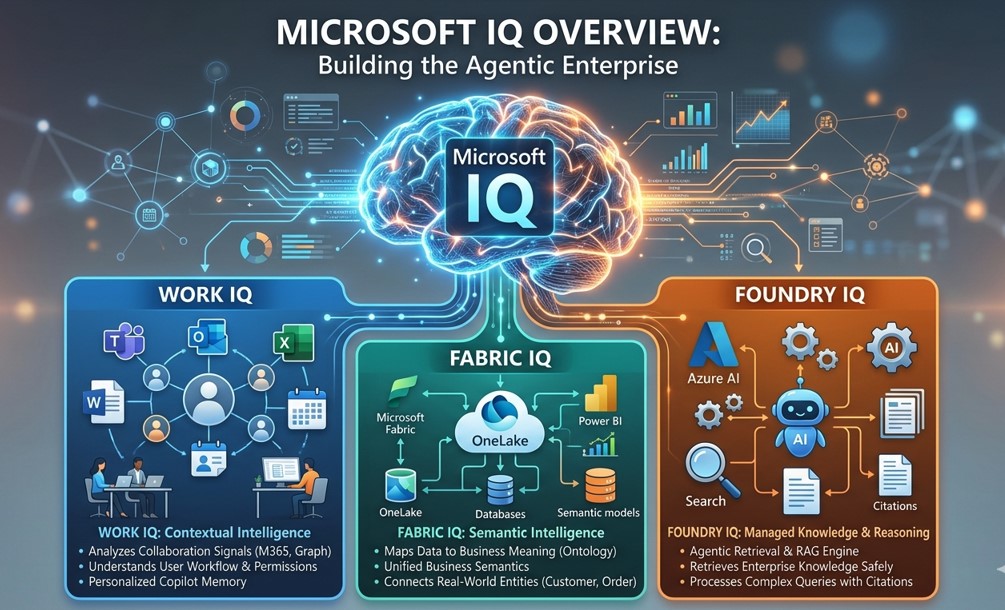
Work IQ, Fabric IQ, and Foundry IQ
Large language models are highly capable at processing text, but they have historically lacked business context. They do not inherently know that “Revenue” may be defined differently by finance and sales, who the key stakeholder for the Apollo Project is, or how to interpret the nuanced language in supplier contracts.
To address this gap, Microsoft has introduced Microsoft IQ as an enterprise intelligence layer across its ecosystem. Rather than a set of standalone products, it is better understood as a capability framework spanning three areas: Work IQ, Fabric IQ, and Foundry IQ.
Together, these capabilities support what Microsoft describes as the agentic enterprise, shifting AI from a reactive assistant toward a more proactive digital collaborator. The sections below explain the role each layer plays.
1. Work IQ: Contextual Intelligence
The Foundation: Microsoft 365, Microsoft Teams, and Microsoft Graph.
Work IQ strengthens Microsoft 365 Copilot by carrying forward relevant user and organizational context across interactions. While Microsoft Graph reflects the formal organization chart, Work IQ adds a dynamic view of how work actually gets done by capturing patterns across day-to-day collaboration.
- What it does: It continuously analyzes collaboration signals, emails, Teams transcripts, calendar events, and shared documents to understand real-world working relationships.
- Key capability: Conversational memory. Work IQ introduces persistent memory, so Copilot can retain relevant preferences, workflow patterns, and context across sessions.
- Why it matters: It shifts AI from generic responses to highly personalized interactions. It understands who you collaborate with most, the status of your active projects, and how your team gets things done.
2. Fabric IQ: Semantic Intelligence
The Foundation: Microsoft Fabric, OneLake, and Power BI.
Data platforms are typically filled with fragmented tables, isolated databases, and conflicting definitions. Fabric IQ brings business ontology to enterprise data. Instead of treating data as sterile rows and columns, Fabric IQ maps data to real world business entities.
- What it does: It allows an organization to define shared business concepts like “Customer,” “Order,” or “Net Revenue” exactly once. It then binds these definitions to the data living in OneLake.
- Key capability: Unified business semantics. Existing Power BI semantic models can help create a live, navigable knowledge graph of the enterprise.
- Why it matters: It ensures that every human and AI agent across the company speaks the exact same data language. When an agent looks at a dashboard, it doesn’t just see numbers; it understands the operational context of how the business runs.
3. Foundry IQ: Managed Knowledge & Reasoning
The Foundation: Azure AI Foundry and Azure AI Search.
Building retrieval-augmented generation (RAG) pipelines that connect AI models to enterprise documents has traditionally required significant custom development. Teams often had to integrate multiple data sources, manage permissions, and design complex retrieval logic. Foundry IQ provides a managed knowledge and retrieval layer that simplifies this process.
- What it does: It centralizes multi-source knowledge bases (SharePoint, Azure Blobs, Fabric OneLake, web data) into a single endpoint.
- Key capability: Agentic retrieval. When an agent queries Foundry IQ, a smaller model can break the request into parallel sub queries, search across sources, re-rank the results semantically, and return a unified answer with citations.
- Why it matters: It drastically reduces AI hallucinations. Crucially, it runs queries using Microsoft Entra ID role-based access control, meaning agents will never surface a document or answer using data that the requesting user doesn’t have explicit permission to see.
How the Layers Work Together: A Real-World Scenario
The true power of Microsoft IQ is realized when all three layers operate in tandem. Consider a supply chain exception:
- Fabric IQ detects an anomaly: on-time delivery metrics are declining for a specific regional supplier.
- Foundry IQ retrieves the active supplier contract to identify relevant SLA and penalty clauses.
- Work IQ identifies the procurement team managing the vendor and drafts a targeted outreach email.
By combining data meaning (Fabric IQ), enterprise knowledge (Foundry IQ), and user context (Work IQ), an AI agent can proactively flag a business crisis, cross-reference it against corporate legal policy, and draft a tailored email to the correct point of contact before a human even opens a dashboard.
Sum up
Microsoft IQ represents an important shift in enterprise AI architecture. It moves organizations beyond isolated pilots toward a more durable model in which AI can reason across work context, business data, and managed knowledge under governance.
If you are looking to prepare your company for this next wave:
- Start defining your business concepts in Fabric IQ if you are already in the Fabric ecosystem.
- Explore Foundry IQ to build clean, multi-source knowledge bases for custom agents.
- Keep an eye out for Work IQ features as they seamlessly roll into daily Microsoft 365 Copilot updates.

